
Conjunction Junction, what’s your function?
Raise your hand if you learned your early grammar and civics lessons from Saturday morning cartoons.
If you grew up watching Schoolhouse Rock!, those songs probably still live somewhere in your brain.
Conjunction Junction…
I’m just a bill…
Those catchy little animations managed to teach an entire generation how conjunctions work and how a bill becomes a law.
But there’s one critical lesson they never covered.
Assumption Junction.
Where the Idea Came From
The phrase came up recently in a conversation with a friend and fellow coach. The moment he said it, my brain immediately jumped to Schoolhouse Rock.
And it made me wonder: What if Gen X had learned emotional intelligence from those cartoons too?
What if there had been an episode explaining how quickly the mind moves from observation to assumption?
The Episode I Imagine
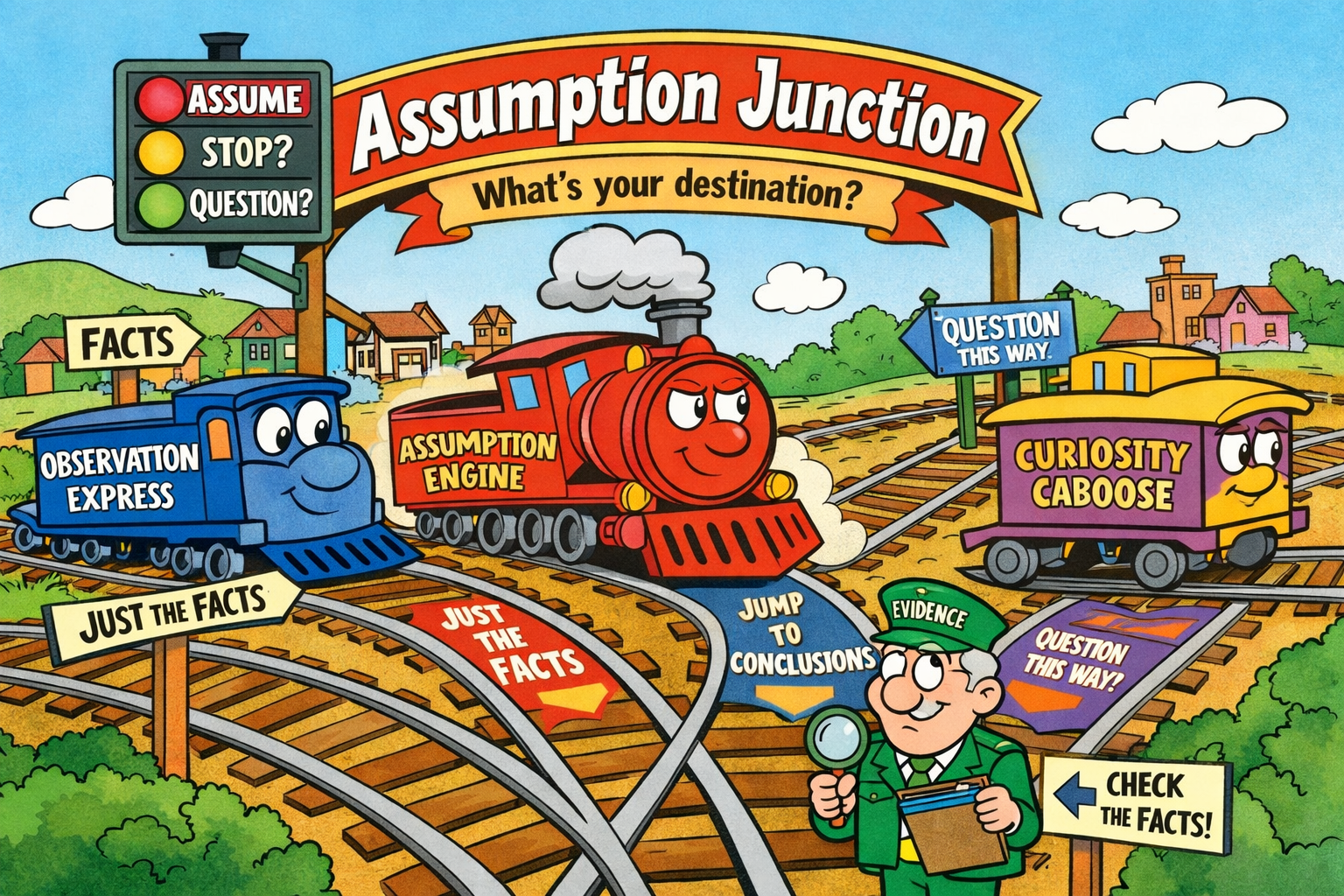
In my mind, the episode takes place in a colorful train yard called Assumption Junction, where thoughts travel as trains.
Tracks split in different directions depending on how the brain interprets what just happened.
The characters might include:
- Observation Express – the train that carries only what actually happened
- Assumption Engine – the train that rushes ahead and fills in the blanks
- Curiosity Caboose – the slower train that asks questions before leaving the station
- Evidence Station Master – the one who checks whether the story is actually true
In my imagined episode, a simple moment triggers the action.
Someone waves to a friend in the hallway, but the friend walks right past them.
Observation Express leaves the station: My friend walked past me.
But before long, Assumption Engine is racing down another track: They’re ignoring me.
Within seconds, the mind has created a story.
Cue the catchy chorus:
Assumption Junction… what’s your function?
Jumping to conclusions without instruction…
The Lesson We Learned Later
If Schoolhouse Rock had made Assumption Junction, I suspect many of us would have learned early on how quickly the mind moves from:
observation → interpretation → emotion
Instead, many of us learned that lesson the hard way in working teams.
For example:
- A colleague pushes back on an idea in a meeting
- Someone takes longer than expected to reply to your message
- A leader’s facial expression shifts during your presentation
Immediately, Observation Express is out of the station, chugging down the track.
But guess who also leaves the station immediately, Assumption Engine starts rolling too.
They’re trying to block this.
They aren’t interested.
They’re undermining me.
Within seconds, the brain fills in the blanks.
The Ladder We Climb Without Realizing
Organizational psychologist Chris Argyris described this pattern as the Ladder of Inference.
The model explains how people move from observable data to conclusions and actions.
Typically, it unfolds like this:
- We observe something real
- We select the details that stand out to us.
- We add meaning based on past experience.
- We draw conclusions.
- We form beliefs.
- We act as though those beliefs are facts.
The entire climb can happen in seconds. As a result, by the time tension appears in a team conversation, people are often reacting not to what was actually said or done, but to the meaning they assigned along the way.
Catching Ourselves at Assumption Junction
I catch myself doing this more often than I’d like.
The brain is incredibly efficient at building stories from incomplete information.
However, efficiency isn’t the same thing as accuracy.
What helps is a small but powerful pause.
A moment to ask:
- What did I actually observe?
- What meaning am I adding that may come from past experiences rather than this moment?
- That brief pause can slow down Assumption Engine long enough for Curiosity Caboose to pull into the station.
Why This Matters for Teams
In leadership and team dynamics, that pause can change the entire conversation.
Many workplace tensions don’t begin with disagreement.
Instead, they begin with interpretations that were never verified.
Once those interpretations harden into beliefs, people begin responding to the story they’ve constructed rather than the situation.
And that’s when communication gets tangled.
The Next Time You Arrive at Assumption Junction
Maybe if Schoolhouse Rock! had included Assumption Junction, more of us would have learned this lesson earlier.
Instead, most of us learned it later, in meetings, team dynamics, and difficult conversations.
The good news is that the skill can be practiced.
Try this experiment this week.
The next time tension shows up in a conversation, pause and ask:
- What did I actually observe?
- What meaning am I adding?
- What question might help me check that assumption?
That small pause can slow down Assumption Engine long enough for Curiosity Caboose to pull into the station. Many of the leadership challenges I see in teams begin at Assumption Junction. Helping leaders slow down that moment is a big part of the coaching work I do.